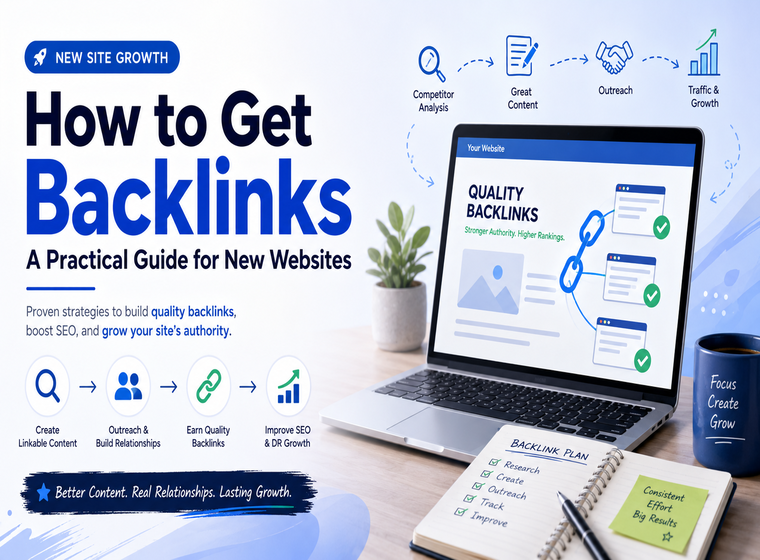
Getting backlinks for a new website is difficult because new sites have no reputation yet. That is exactly why many founders make bad link-building decisions early: they buy cheap links, submit to every low-quality site they can find, or copy competitor anchors without understanding the risk.
My opinion: a new website should not try to look popular overnight. It should try to become easy to discover, easy to trust, and easy to reference.
This guide explains how to get backlinks for a new website in a safer way, how backlinks connect to SEO, and how they can support DR growth over time.
What Is SEO and Why Do Backlinks Matter?
SEO means search engine optimization. The goal is to help search engines understand, crawl, index, and rank your pages for relevant searches.
For a new site, SEO usually needs four foundations:
1.Crawlability: Search engines can access your pages.2.Indexability: Your pages are allowed to appear in search.3.Relevance: Your content matches a clear search intent.4.Authority: Other trusted pages reference your site.
Backlinks support the authority and discovery parts. A backlink from another website gives search engines another path to find your page and another signal that your page may be worth understanding.
But backlinks only work well when the page itself is worth visiting. If the page is thin, confusing, or irrelevant, links cannot turn it into a strong SEO asset.
The Best Backlink Strategy for New Sites
The best backlink strategy for a new site is not "get as many links as possible."
It is:
- Publish pages with a clear purpose.2. Make those pages easy to cite.3. Place the site in relevant discovery channels.4. Build relationships that can lead to natural mentions.5. Track which links bring useful traffic or indexing improvements.
For a product site, this could include a strong homepage, category pages, a few educational blog posts, and a listing in relevant product discovery channels. If you are listing a product on ToolListed, the submit page is one possible distribution path, but this article focuses on a broader backlink process.
Step 1: Build Linkable Pages Before Asking for Links
Before outreach, ask: "What would someone actually link to?"
Good linkable assets include:
- A beginner guide.- A checklist.- A comparison page.- A free template.- A useful calculator.- A curated list.- A data-backed opinion article.- A product page with clear use cases.
For example, an article explaining "how to get backlinks for a new website" is more linkable than a generic sales page because it teaches something.
Step 2: Use Long-Tail Keywords First
New websites usually struggle with broad keywords. Broad terms like "backlinks" or "SEO" are competitive. Long-tail keywords are better starting points because they usually reveal a more specific intent.
Examples of useful long-tail targets:
- how to get backlinks- how to build backlinks- what are backlinks in SEO- competitor backlink analysis- check backlinks to your site- backlink profile- quality backlinks
The key is to map one page to one intent. Do not make one article target every backlink keyword at once.
Step 3: Learn From Competitor Backlink Analysis
Competitor backlink analysis means looking at where similar websites get links.
You are not trying to copy every link. You are looking for patterns.
Ask:
- Which blogs mention competitors?- Which directories list them?- Which resource pages include them?- Which comparison articles rank for related terms?- Which communities discuss their product category?
Then decide which opportunities are realistic for your site.
For example, if three competitors are listed in curated tool collections, that suggests curated lists are a valid channel. If competitors have links from spammy foreign-language pages unrelated to the niche, ignore those.
Step 4: Get Indexed Through Relevant Discovery Channels
For new sites, some early backlinks are valuable because they help discovery. Search engines can find your pages through already-indexed pages.
Relevant channels may include:
- Product directories.- Niche tool collections.- Startup launch pages.- Partner pages.- Founder interviews.- Newsletter mentions.- Resource pages.- Guest tutorials.
The important word is relevant. A backlink from a page that your target audience might actually visit is usually more useful than a random link on a generic site.
You can also connect your educational content to relevant internal pages like the ToolListed categories page, pricing page, or home page when it helps the reader continue their research.
Step 5: Write Outreach That Deserves a Reply
Most outreach fails because it asks for value before giving value.
Bad outreach:
"Please link to my website."
Better outreach:
"I noticed your article lists resources for early-stage SaaS founders. We published a practical guide on building backlinks safely for new websites. It may fit your section on SEO basics because it explains backlink quality, DR, and beginner mistakes."
Useful outreach is specific:
- Mention the page.- Explain why your resource fits.- Show what the reader gains.- Do not overpromise.- Keep it short.
Step 6: Avoid Buying Cheap Backlinks
Buying backlinks is tempting because it feels measurable. You pay money and receive links.
But cheap backlinks often come with problems:
- Irrelevant pages.- Spammy anchors.- Thin content.- Unindexed sources.- Sudden unnatural link patterns.- No real referral traffic.
If a link exists only to manipulate rankings and offers no user value, it is not a durable SEO asset.
My recommendation: spend effort on assets and distribution before paid link placements. If you ever pay for promotion, make sure it is a legitimate sponsorship or listing, not a hidden link scheme.
Step 7: Understand How Backlinks Can Improve DR
DR is a third-party metric that estimates domain authority based on backlinks. It is not a direct Google ranking factor.
Backlinks can support DR when:
- They come from domains with their own authority.- They are followed or at least discoverable.- They are contextually relevant.- They point to pages that make sense.- They are part of a natural backlink profile.
But do not chase DR alone. A lower-DR site with qualified traffic, strong content, and real mentions can be healthier than a higher-DR site built from irrelevant links.
Step 8: Monitor Links and Improve the Pages That Earn Them
Once you start earning backlinks, track what happens.
Watch for:
- Which pages get links.- Which anchors are used.- Which links send traffic.- Which pages become indexed faster.- Which pages need better internal links.- Which links look suspicious.
If one article earns links naturally, improve it. Add examples, visuals, internal links, FAQs, and a clearer call to action.
SEO is not just publishing. It is improving what starts to work.
A 30-Day Backlink Plan for New Websites
Week 1: Build the Foundation
- Make sure your site can be crawled.- Create a sitemap.- Add clear page titles and descriptions.- Publish one strong educational page.- Add internal links from related pages.
Week 2: Create Linkable Assets
- Publish a checklist or tutorial.- Add examples.- Include a short FAQ.- Make the article easy to reference.
Week 3: Find Relevant Link Opportunities
- Review competitor backlinks.- Find curated lists.- Identify newsletters and blogs.- Look for communities where your audience is active.
Week 4: Outreach and Iterate
- Send targeted outreach.- Share the asset in relevant communities.- Track responses.- Improve the page based on questions you receive.
Common Mistakes to Avoid
Mistake 1: Building Links to the Wrong Page
Do not send every backlink to the homepage. Link to the page that best matches the context.
Mistake 2: Using Exact-Match Anchors Too Often
Natural anchor text varies. Repeating the same commercial phrase everywhere can look forced.
Mistake 3: Ignoring No-Click Value
Some mentions may not send much traffic immediately but still help discovery, brand visibility, or future outreach.
Mistake 4: Publishing Without Internal Links
Your own website should guide visitors. A blog post about backlinks can link to relevant categories, pricing, or submission paths when useful.
Final Takeaway
If you want to get backlinks for a new website, start with usefulness. Create pages worth referencing, target long-tail search intent, use competitor analysis to find realistic opportunities, and build links from relevant sources.
Backlinks can help SEO and may support DR growth, but only when they are part of a real visibility strategy. The safest backlink is not the easiest one to buy. It is the one that makes sense to a real reader.