Newsletter
Join the Community
Subscribe to our newsletter for the latest news and updates
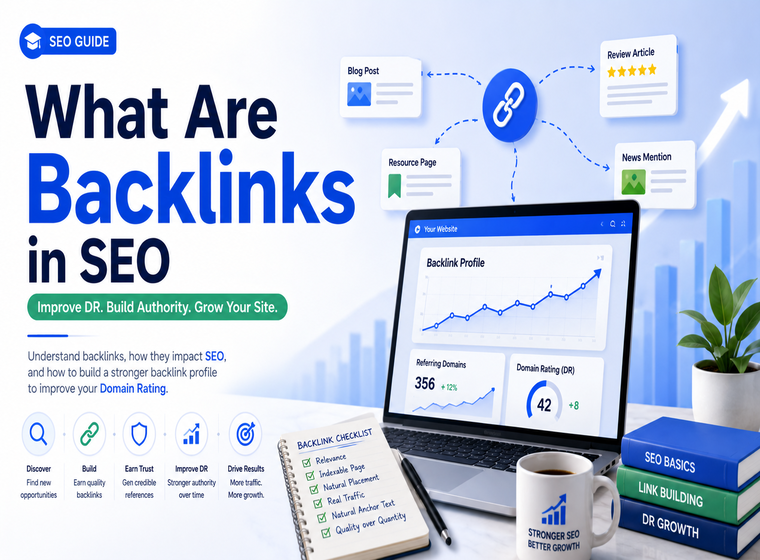
Learn what backlinks are in SEO, how quality links can support DR growth, and how to build a safer backlink profile with practical examples and checks
2026/05/06
Backlinks are one of the most misunderstood parts of SEO. Many founders hear that they need "more links" and immediately start chasing numbers: 100 links, 500 links, 1,000 links. That is the wrong frame.
My view is simple: backlinks are not a shortcut to authority. They are public evidence that other websites are willing to reference your page. When the evidence is relevant, credible, and natural, it can help search engines trust your site faster.
This guide explains what backlinks are in SEO, how they relate to DR, and how a small website can build a stronger backlink profile without turning link building into spam.
SEO stands for search engine optimization. It is the process of making a website easier for search engines and users to understand.
A useful SEO strategy usually has three parts:
1.Technical SEO: Can search engines crawl and index your pages?2.Content SEO: Does each page answer a clear search intent?3.Authority SEO: Do other websites have enough reason to reference you?
Backlinks belong mostly to the third part. They are not the whole SEO strategy, but they can make good pages more competitive.
If your site is still new, start with crawlable pages, clear titles, and useful content. Then use relevant mentions and links to help those pages get discovered. ToolListed's home page is designed around product discovery, while the submit page is for founders who want to list a product. This article is different: it focuses on understanding backlinks as an SEO asset.
A backlink is a link from one website to another website.
For example, if a blog post about productivity tools links to your product page, your page has received a backlink from that blog.
In SEO, backlinks matter because they can act like signals of:
-Discovery: Search engines can find your page through another indexed page.-Relevance: The linking page gives context about your topic.-Trust: A credible site linking to you can support your authority.-Popularity: Multiple independent references can suggest your page is useful.
But not every backlink is equally useful. A relevant link from a niche article can be better than dozens of random links from unrelated pages.
Backlinks and internal links are often confused.
Backlinks come from other domains. They help your site earn external authority.
Internal links come from your own domain. They help users and search engines understand how your pages connect.
Both matter. A new product page with no internal links and no backlinks is hard to discover. A page linked from your navigation, related articles, and a few relevant external pages has a better chance of being crawled and understood.
For example, a useful blog article can internally link to:
DR usually means Domain Rating, a third-party metric popularized by SEO tools. It estimates the strength of a domain's backlink profile.
Important: DR is not a Google ranking factor. Google does not use your Ahrefs DR score directly.
However, DR can still be useful as a directional metric. If your site consistently earns links from relevant and trusted websites, third-party authority metrics often improve over time.
The mistake is treating DR as the goal. The real goal is stronger discoverability and trust. DR is only a proxy.
Backlinks can support DR growth when they come from sites that already have authority and are topically relevant.
A backlink may help more when:
Before chasing any backlink, ask these questions:
1.Is the page relevant? A link from a related article or directory page is usually stronger than a link from an unrelated page.
2.Is the page indexable? If Google cannot index the page, the discovery value may be limited.
3.Is the link placed naturally? A link inside helpful editorial content is usually more credible than a link dumped in a footer.
4.Would a real user click it? If the answer is no, the link may be weak even if a tool reports it.
5.Is the anchor text believable? Over-optimized anchors like "best free SEO backlink ranking tool" repeated everywhere can look unnatural.
6.Does the page send qualified visitors? A small but relevant referral source can be more valuable than a large irrelevant one.
Many backlink guides start with outreach. I think that skips the most important step.
First, create something worth referencing:
Here is a simple teaching workflow for a new site:
Do not make one page target five topics. One page should answer one clear question.
Example:
The page should answer the searcher's next question before they ask it.
For a beginner backlink guide, that means explaining:
Link to related pages on your own site. This helps search engines understand your site structure.
For example, a product discovery site can link from educational articles to:
Look for places where your page genuinely helps:
Use a backlink checker or search console data to see which pages attract links. Do not obsess over every number. Look for patterns:
Buying links to a weak page does not fix the page. It only adds risk.
Some directory listings are useful because they are curated, indexed, and relevant. Others are thin pages with little value.
If your own site does not link to a page, why should other sites treat it as important?
A higher DR score feels good, but qualified visitors and indexed pages matter more.
Backlinks in SEO are not magic votes. They are references. Good references help search engines and users understand why your page matters.
If you want a stronger backlink profile, start by creating pages that deserve links, connect them with useful internal links, and then earn relevant external references. DR may improve as a side effect, but the better goal is durable visibility.
For founders, that means building pages people can actually use, not just pages created to collect links.