What is CyberScore Labs?
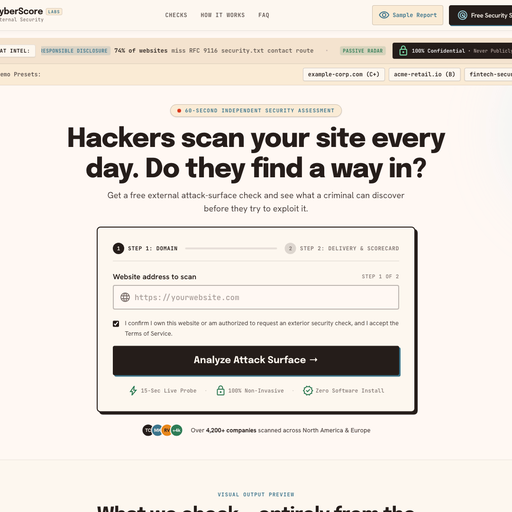
CyberScore Labs is a free, outside-in security check built for small businesses. You type in your website address, and roughly twenty seconds later you get a letter grade, a list of plain-English findings, and the exact fix to hand to your IT person. Nothing is installed, no passwords are requested, and no access to your internal systems is needed. The tool only reads what anyone on the internet can already see: public DNS records, the HTTPS certificate your site presents, ordinary web pages, Shodan's existing scan data, and public certificate transparency logs.
The problem it solves is a familiar one. Most small companies have no security team and no budget for a full penetration test, yet the doors attackers try first are usually visible from the outside — a missing DMARC record that lets a stranger send a forged invoice from your domain, an end-of-life PHP version, an outdated WordPress plugin, a database port left open to the world, or a forgotten staging subdomain still resolving to a test site. CyberScore Labs bundles these checks into a single scan and translates the results into something a non-technical owner can act on, rather than a wall of CVEs.
The scan is powered by data refreshed daily. Email findings come from public DNS (SPF, DKIM, DMARC, MTA-STS, TLS-RPT, plus detection of Microsoft 365 or Google Workspace as your mail provider). Website findings come from a single normal browser-style visit that reads the certificate, checks for old TLS versions, verifies the HTTP to HTTPS redirect, inspects security headers such as HSTS, Content-Security-Policy and clickjacking protection, and probes for files that should never be public like .git, .env, config backups, debug logs and phpinfo. Software versions detected on your servers, CMS and JavaScript libraries are matched against endoflife.date, NVD, OSV, CISA's Known Exploited Vulnerabilities list and WordPress.org. Attack surface findings combine certificate transparency subdomain discovery with open services and appliances that Shodan already sees — Remote Desktop, databases, file sharing, FTP, admin panels, and gear from Fortinet, Palo Alto, Ivanti, Citrix and SonicWall.
Critically, the platform is read-only by design. It never attempts a login, never sends attack traffic, never runs its own port scans, and does not monitor breach databases or scan for malware. Results are never published, sold or shared, and the site is explicit that you should only scan domains you own or have written permission to check.
Key Features of CyberScore Labs
- Email spoofing check — The scan reads your public DNS to see whether a stranger could send a fake invoice from your own address. It inspects SPF (single record, the "all" rule, lookup count), DKIM signing selectors including Microsoft 365, DMARC policy, reporting address and percentage, plus MTA-STS and TLS-RPT for delivery security.
- Known vulnerability matching — Detected versions of server software (PHP, Apache, nginx, OpenSSL, Tomcat, Node.js, databases, Exchange), CMS platforms (WordPress, Drupal, Joomla, Magento, TYPO3) with plugins and themes, and JavaScript libraries like jQuery and Bootstrap are matched against flaw data refreshed every day. Results are cross-referenced with endoflife.date, NVD, OSV and CISA KEV so you see which issues attackers are actually exploiting right now.
- Website and HTTPS inspection — A single normal visit verifies certificate trust, domain match and expiry, and flags TLS 1.0 or 1.1 still being offered. It also checks the HTTP to HTTPS redirect and missing security headers such as HSTS, Content-Security-Policy and X-Frame-Options, which are cheap fixes that close common browser-level attacks.
- Exposed file discovery — The scanner looks for files and folders that should stay private, including .git, .env, configuration backups, debug logs, phpinfo pages and open folder listings. It also checks for exposed WordPress usernames and the presence of a security.txt file.
- Attack surface mapping — Certificate transparency logs are used to surface forgotten subdomains, test sites and old hosts that still point at your infrastructure. This is combined with Shodan's view of your servers, which may already show open Remote Desktop, database, FTP, file-sharing and admin panel ports.
- Plain-English graded report — Every scan produces a score out of 100 with a letter grade, a prioritised list of issues split into urgent and worth-fixing categories, and a written explanation of each finding. A public sample report shows the format: 68/100, a C+ grade, six issues with two flagged urgent.
- No-install, read-only design — There is nothing to deploy and no credentials to hand over. The service explicitly never logs in, never exploits anything, does not run port scans of its own and does not watch breach databases, so it can be run against production without disrupting visitors.
- Daily-refreshed threat data — CISA, NVD, Shodan, OSV and endoflife.date feeds are refreshed every day, so a scan reflects the flaws being used today rather than a year-old snapshot. The site is transparent that version matches can miss patches applied quietly and should be confirmed with whoever runs your site.
How much is CyberScore Labs?
CyberScore Labs is free to use and requires no credit card. The site states plainly that if you want help fixing what the scan finds, you can ask them, and that part is optional and up to you. No specific price list for remediation or support services is published on the page.
Who is CyberScore Labs for?
This tool is aimed at small business owners, office managers and operations leads who do not have an in-house security team but do have a website, a domain and business email. It is equally useful for the IT generalist or managed service provider who looks after several small clients, since the report hands them a prioritised, plain-English worklist instead of a raw vulnerability dump. Typical use cases include pre-onboarding due diligence, an annual sanity check before insurance renewal, checking whether a newly registered domain is ready for email, and verifying that a fix actually landed after a developer ships it.
It is the right choice when you need a fast, non-invasive first look at external exposure — email authentication gaps, stale software, forgotten subdomains, exposed admin ports — and you want findings written for a business audience rather than a security engineer. It is not a penetration test, a malware scanner or a breach-monitoring service, and the vendor says so directly. If you need hands-on exploitation testing, continuous breach alerts or full compliance certification work, this complements but does not replace those engagements.